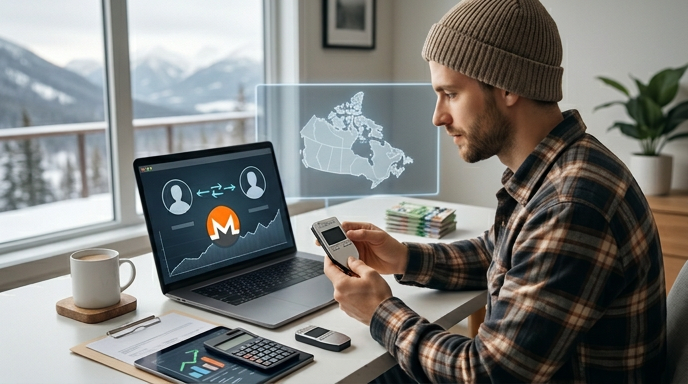
How to Buy Monero (XMR) in Canada 2026: P2P, Non‑Custodial Swaps, Self‑Custody & CRA Tax
If you want to buy Monero in Canada in 2026, this guide walks you through practical, legal, and privacy-respecting pathways. "Buy Monero Canada 2026" buyers need specific steps: where XMR is listed, peer-to-peer and non-custodial swap options, how to secure XMR with self-custody (including hardware wallet considerations), and what the Canada Revenue Agency expects for reporting and tax. This article focuses on actionable methods for Canadians, risks to avoid, and a clear next-step checklist.
Table of Contents
- Table of Contents
- Quick overview and Canadian context
- How Canadians can buy Monero: methods compared
- Which method should you choose?
- Step-by-step: Buying Monero (P2P and non-custodial swaps)
- A. Peer-to-peer purchase (Interac or bank transfer)
- B. Non-custodial swap (atomic or routed swaps)
- Self-custody and hardware wallet setup for Monero
- Recommended wallet options
- Practical security steps
- CRA tax and record-keeping for Monero (practical guidance)
- Key record-keeping steps
- Legal, banking, and privacy risks — what Canadians should know
- If an exchange or bank freezes funds
- Frequently asked questions (FAQ)
- 1. Can I buy Monero with Interac e-Transfer in Canada?
- 2. Is holding Monero legal in Canada?
- 3. Do hardware wallets support Monero?
- 4. Will trading XMR trigger CRA audits?
- 5. How can I move CAD to a swap service safely?
- Conclusion and next-step checklist
- Immediate next-step checklist
Table of Contents
- #overview - Quick overview and Canadian context
- #methods - How Canadians can buy Monero: methods compared
- #step-by-step - Step-by-step guide (P2P and non-custodial swaps)
- #security - Self-custody and hardware wallet setup
- #tax - CRA tax and record-keeping for XMR
- #risks - Legal, banking, and privacy risks
- #faq - Frequently asked questions
- #conclusion - Conclusion and next-step checklist
Quick overview and Canadian context
Monero (XMR) is a privacy-focused cryptocurrency that emphasizes transaction confidentiality and unlinkability. Compared with Bitcoin and many altcoins, XMR is less available on regulated Canadian exchanges due to compliance and delisting trends. That means most Canadians who want XMR use peer-to-peer marketplaces, non-custodial on-chain swaps, or international exchanges that still list XMR. Always consider how your bank, FINTRAC, and the Canada Revenue Agency (CRA) may view transactions involving privacy coins, and prioritize safety, verifiable counterparties, and clear records.
How Canadians can buy Monero: methods compared
| Method | How it works | Pros | Cons |
|---|---|---|---|
| Peer-to-peer (P2P) marketplaces | Buy XMR directly from other Canadians or international sellers using Interac e-Transfer, bank transfer, or cash. | Good privacy, local pricing, flexible payment methods. | Counterparty risk, potential bank scrutiny, need for escrow or trusted reputation. |
| Non-custodial swaps / DEX-like services | Use atomic-swap services or intermediary tokens and non-custodial bridges to swap BTC/ETH/stablecoins for XMR without giving up custody. | Lower counterparty custody risk, can maintain privacy post-swap. | Technical complexity, on-chain fees, limited liquidity. |
| International exchanges (non-Canadian) | Use a reputable overseas exchange that lists XMR; deposit BTC or stablecoins from a Canadian exchange and trade for XMR. | Higher liquidity, familiar exchange UX. | KYC may be required, regulatory risk, withdrawal limitations to privacy coin addresses. |
| Over-the-counter (OTC) or local cash | Large-volume trades arranged privately; can be bank deposit or cash. | Good for large buys, negotiated pricing. | Trust and legal risk; strong documentation required. |
Which method should you choose?
For most Canadian retail buyers, start with P2P platforms that provide escrow and reputation systems or use a non-custodial swap if you are technically comfortable. If you prefer a simpler route and are willing to accept centralized custody temporarily, you can buy BTC or stablecoins on a regulated Canadian exchange and then use a trusted international trading venue to swap to XMR, withdrawing immediately to self-custody.
Step-by-step: Buying Monero (P2P and non-custodial swaps)
A. Peer-to-peer purchase (Interac or bank transfer)
- Choose a P2P marketplace with escrow and a strong reputation. Verify seller history, trade volume, and user reviews.
- Create and verify accounts as required while using a secure email and 2FA. Keep account info minimal and factual.
- Open a trade and confirm payment method. Interac e-Transfer is common in Canada, but be aware of bank monitoring for crypto-related transfers.
- Use the marketplace escrow. Do not release funds until the platform confirms the seller has deposited XMR into escrow or transferred to your external address.
- Send payment using the agreed method. Keep all receipts and screenshots for your records and tax reporting.
- After escrow release, move XMR to your personal wallet (self-custody) immediately.
B. Non-custodial swap (atomic or routed swaps)
- Purchase a commonly swapped asset on a Canadian exchange (BTC, ETH, or a CAD stablecoin).
- Use a reputable non-custodial swap service that supports XMR or a routed swap path (example: BTC to XMR via a privacy-preserving intermediate). Verify that the swap does not require custody of your funds longer than necessary.
- Provide a fresh XMR receiving address from your Monero wallet (do not reuse addresses to preserve privacy).
- Confirm estimated fees and execution steps. Complete the swap and wait for on-chain confirmations.
- Verify receipt of XMR and run a small test swap first to confirm the workflow.
Self-custody and hardware wallet setup for Monero
Once you hold XMR, secure it with self-custody. Monero uses different address and signing schemes than Bitcoin and Ethereum, so confirm wallet compatibility before withdrawing XMR from any platform.
Recommended wallet options
- Official Monero GUI or light wallets that support XMR privacy features.
- Ledger hardware wallet with Monero app integration (follow official Ledger and Monero instructions carefully).
- Paper wallet or air-gapped seed backups for long-term cold storage.
Practical security steps
- Buy hardware wallets from official vendors and verify device authenticity. See guidance on supply-chain verification in our hardware wallet security guide: How to verify your hardware wallet and firmware.
- Use a new receiving address for each transaction to protect against address-linking.
- Backup your seed and view keys securely, preferably geographically distributed and encrypted when appropriate.
- Test recovery on another device before storing large amounts.
CRA tax and record-keeping for Monero (practical guidance)
The Canada Revenue Agency treats cryptocurrencies generally as a commodity. That means transactions involving Monero are taxable events when they meet criteria such as disposition or business income. Privacy features do not exempt you from tax reporting obligations.
Key record-keeping steps
- Maintain dated records of purchase receipts, payment method, counterparty identity when available, and the XMR address involved.
- Record the CAD value at the time of acquisition and at disposal for capital gains calculations.
- Keep escrow confirmations, P2P chat logs, and exchange trade history to substantiate your position in case of CRA questions.
- If you receive XMR as income (mining, payment for services), record the fair market value in CAD at the time of receipt and report accordingly.
Legal, banking, and privacy risks — what Canadians should know
Buying and holding a privacy coin carries several practical risks in Canada:
- Some regulated exchanges and payment processors will not support XMR, limiting on-ramp options.
- Banks may flag or decline transfers associated with privacy coin purchases. Keep clear documentation and use reputable, transparent P2P platforms.
- FINTRAC and other regulators scrutinize anonymity-enhancing technologies. Avoid any behaviour that could be perceived as evading law enforcement.
- Counterparty fraud risk is higher on P2P marketplaces. Use escrow and start with small trades to build trust.
If an exchange or bank freezes funds
Follow proven incident steps: retain transaction records, contact the platform or bank promptly, and document all communications. For guidance on response workflows in Canada, review our practical exchange-freeze playbook: What to do when an exchange freezes withdrawals.
Frequently asked questions (FAQ)
1. Can I buy Monero with Interac e-Transfer in Canada?
Some P2P sellers accept Interac e-Transfer, but banks increasingly monitor crypto-related Interac activity. Use escrow, keep receipts, and consider alternative payment methods if you face repeated declines.
2. Is holding Monero legal in Canada?
Yes. There is no blanket ban on owning privacy coins, but regulatory scrutiny is higher. Ensure you comply with anti-money-laundering laws and report taxable events to the CRA.
3. Do hardware wallets support Monero?
Some hardware wallets support Monero via official or community-backed integrations. Confirm current compatibility on the wallet vendor and Monero project pages and follow secure setup procedures. For general guidance on avoiding counterfeit devices and verifying authenticity, read: How to avoid counterfeit hardware wallets in Canada.
4. Will trading XMR trigger CRA audits?
Trading XMR does not automatically trigger audits. However, opaque records or unexplained deposits may draw attention. Maintain thorough, time-stamped records and be prepared to explain the origin and purpose of transactions.
5. How can I move CAD to a swap service safely?
Start by buying BTC or a stablecoin on a Canadian exchange using Interac or bank transfer, then move that asset to a swap or international exchange. Our DeFi on-ramp guide explains secure CAD-to-crypto flows in Canada: DeFi on-ramp options for Canadians.
Conclusion and next-step checklist
Buying Monero in Canada is achievable, but it requires extra attention to counterparty trust, banking behaviour, and self-custody. Prioritize safe, escrowed P2P trades or non-custodial swaps, secure your XMR with verified hardware or Monero-native wallets, and retain clear records for CRA reporting.
Immediate next-step checklist
- Decide on a method: P2P (escrow) or non-custodial swap.
- Set up a Monero-compatible wallet and backup seed/view key. Verify hardware wallet authenticity if using one.
- Start with a small test trade and document everything (receipts, screenshots, timestamps).
- Move XMR to self-custody immediately after purchase and verify recovery.
- Log CAD values and keep trade records for CRA reporting.