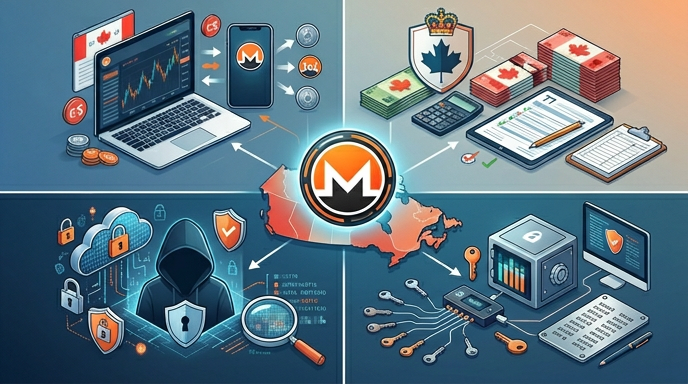
How to Buy Monero in Canada 2026: Where to Buy XMR, Privacy Risks, Self‑Custody & CRA Tax
If you want to buy Monero in Canada 2026, this guide explains how Canadians can safely acquire XMR, the legal and tax considerations under CRA guidance, and practical self-custody workflows. Buying Monero (XMR) differs from buying mainstream coins because many Canadian exchanges do not list privacy coins and banks may flag unusual flows. This article gives step-by-step on‑ramps, secure wallet setup, and recordkeeping templates for CRA reporting so you can make an informed, compliant purchase.
Table of Contents
- Table of Contents
- Overview and Canadian context
- Where to buy Monero in Canada
- 1. Regulated exchanges that still list XMR (limited)
- 2. Buy BTC/ETH or stablecoins on a Canadian on‑ramp, then swap
- 3. Peer-to-peer (P2P) trading
- 4. Over-the-counter (OTC) desks and brokers
- Step-by-step buying workflows (practical)
- A. Recommended: Canadian on‑ramp -> swap -> self-custody
- B. P2P workflow (privacy-focused but higher risk)
- Wallets and self-custody for Monero
- Desktop and mobile wallets
- Hardware wallets and verification
- Backup and recovery
- Privacy, compliance, and safety risks
- 1. Banking and fiat deposits
- 2. Exchange delisting risk
- 3. P2P counterparty risk and escrow checks
- CRA tax rules and recordkeeping for Monero
- Comparison table: Buying methods (pros and cons)
- FAQ — Practical buyer questions
- 1. Is Monero legal to buy in Canada?
- 2. Can I buy Monero directly with Interac e-Transfer?
- 3. How do I safely store Monero long-term?
- 4. Does swapping BTC for XMR create a taxable event?
- 5. What privacy practices should I follow after buying XMR?
- Conclusion — Next steps checklist
Table of Contents
- #overview - Quick overview and Canadian context
- #where-to-buy - Best ways to buy Monero in Canada
- #step-by-step - Step-by-step buying workflows
- #wallets - Wallets and self-custody for Monero
- #privacy-risks - Practical privacy and compliance risks
- #taxes - CRA tax and recordkeeping for XMR
- #comparison - Comparison table: buying methods
- #faq - Frequently asked questions
- #conclusion - Conclusion and next steps checklist
Overview and Canadian context
Monero (XMR) is a privacy-focused cryptocurrency with built-in transaction privacy. In Canada, regulators and banks treat privacy coins cautiously because of anti-money-laundering rules. Many regulated Canadian exchanges do not list XMR, which means Canadian buyers often use peer-to-peer (P2P) methods, international exchanges that accept Canadian residents, or swap from another asset. Each pathway has different custody, privacy, and tax implications. Before you buy, know whether your chosen provider accepts Canadian ID, how funds move from CAD into crypto, and how to securely store XMR.
Where to buy Monero in Canada
There are four practical on‑ramps available to Canadians in 2026. Choose based on your priorities: compliance, privacy, convenience, or cost.
1. Regulated exchanges that still list XMR (limited)
A small number of regulated international exchanges list Monero and accept Canadian users. These platforms typically require KYC and CAD deposits via bank transfer or card. If you find a regulated exchange listing XMR, it is the simplest path but often the most visible for banks and regulators.
2. Buy BTC/ETH or stablecoins on a Canadian on‑ramp, then swap
Most Canadians buy CAD->BTC/ETH/USDC using Interac e-Transfer or a regulated Canadian exchange, then swap for XMR using a non-custodial swap service or an exchange that supports XMR trading pairs. For general guidance on moving CAD to decentralized venues and using stablecoins as a bridge, see this primer on moving CAD to DEXs and the guide on buying stablecoins with CAD.
3. Peer-to-peer (P2P) trading
P2P marketplaces let you trade CAD for XMR directly with another person. These trades require caution: confirm identity, use escrow services when available, and prefer established marketplaces with dispute resolution. P2P offers more privacy than regulated CEXes but higher counterparty risk.
4. Over-the-counter (OTC) desks and brokers
If you are buying a large position, an OTC broker that supports privacy coins can execute a bilateral trade with lower slippage. OTC requires KYC and is best for high-value buyers who need execution guarantees and privacy from public order books.
Step-by-step buying workflows (practical)
A. Recommended: Canadian on‑ramp -> swap -> self-custody
- Open an account at a Canadian-friendly fiat exchange and complete KYC.
- Deposit CAD via Interac e-Transfer or bank transfer.
- Buy BTC or USDC as the intermediary asset.
- Move BTC/USDC to a non-custodial wallet or an exchange that supports XMR trading pairs.
- Use a reputable swap or trading pair to exchange BTC/USDC for XMR.
- Transfer XMR to a Monero wallet where you control the keys (see wallet section).
B. P2P workflow (privacy-focused but higher risk)
- Choose a P2P marketplace with escrow and a good reputation.
- Verify the counterparty using platform tools and check ratings.
- Use platform escrow to complete the CAD payment via Interac or e-Transfer when available.
- Only release funds from escrow after you have received XMR in your wallet and verified the transaction.
Wallets and self-custody for Monero
Monero uses different wallet software and key formats than Bitcoin. You must choose a wallet that supports Monero private keys and seed phrases, and that you can fully control.
Desktop and mobile wallets
- Monero GUI wallet (desktop) - full node option for maximum privacy and trust.
- Monero CLI - advanced users who want deterministic control and scripting.
- Mobile light wallets - good for convenience but trust the source and verify binaries.
Hardware wallets and verification
Ledger devices support Monero through a dedicated app and are recommended for long-term storage. Always verify the device and firmware authenticity before use. For best practice on verifying hardware devices, follow the hardware verification guidance in this article on verifying hardware wallet authenticity.
Backup and recovery
- Write down your Monero seed phrase on paper and store it in at least two geographically separated secure locations.
- Test your backup with a recovery drill (use a small test amount first).
- Do not store seeds in cloud storage or email.
Privacy, compliance, and safety risks
Monero’s privacy features create extra scrutiny from exchanges, banks, and regulators. Understand these practical considerations:
1. Banking and fiat deposits
Your bank may flag large or repeated transfers for AML review when funding crypto purchases that later convert to privacy coins. Maintain clear records of why you bought crypto and keep receipts of CAD transactions.
2. Exchange delisting risk
Some regulated exchanges may delist XMR. If XMR is delisted at your custodian, move funds to self-custody promptly to avoid being unable to withdraw.
3. P2P counterparty risk and escrow checks
When using P2P, always use platforms with escrow and dispute resolution. For Interac e-Transfer, confirm recipient details and be mindful of reversible payment scams.
CRA tax rules and recordkeeping for Monero
The Canada Revenue Agency treats cryptocurrency as a commodity. Buying, selling, and exchanging XMR may trigger capital gains or business income events depending on your activity. Key recordkeeping steps:
- Record date, CAD value at time of each buy/sell/exchange, counterparty or platform, and transaction IDs.
- If you swap BTC->XMR, capture the CAD cost basis of the BTC and the CAD equivalent value of XMR received at the time of the swap.
- Keep bank and exchange statements showing CAD flows for audit trails.
- If you operate a trading business, consult a tax professional because frequency and intent can change tax classification.
Good recordkeeping reduces friction if you receive inquiries related to privacy coin purchases. CRA expects fair market value reporting when disposing or trading crypto.
Comparison table: Buying methods (pros and cons)
| Method | Pros | Cons |
|---|---|---|
| Regulated exchange (lists XMR) | Convenient, custodial liquidity, fiat rails | High visibility, KYC required, delisting risk |
| Swap from BTC/USDC | Uses familiar on‑ramps, flexible | Requires intermediate trades, on-chain cost, potential privacy leakage |
| P2P | Better privacy, may avoid exchanges | Counterparty risk, escrow reliance, slower |
| OTC | Low slippage, tailored execution | KYC, minimums, fees |
FAQ — Practical buyer questions
1. Is Monero legal to buy in Canada?
Yes, Monero is legal to own in Canada. However, because of AML concerns some Canadian institutions and exchanges restrict or delist privacy coins. Comply with KYC and keep tax records for CRA reporting.
2. Can I buy Monero directly with Interac e-Transfer?
Direct purchases of XMR with Interac are rare. The common pattern is buy CAD->BTC/USDC via Interac, then swap to XMR. Use reputable platforms and escrow for P2P Interac trades.
3. How do I safely store Monero long-term?
Use a hardware wallet that supports Monero, verify device authenticity, and store seed phrases offline in multiple secure locations. See hardware verification guidance above for extra safety.
4. Does swapping BTC for XMR create a taxable event?
Yes. Exchanging one crypto for another is a disposition for CRA purposes and may trigger capital gains or business income depending on your activity. Record the CAD value of assets at swap time.
5. What privacy practices should I follow after buying XMR?
- Use a dedicated Monero wallet, not pooled or custodial addresses.
- Avoid reusing addresses.
- If moving between coins, be mindful that on-chain linking can reduce privacy.
Conclusion — Next steps checklist
Below is a concise checklist for Canadians ready to buy Monero in 2026. Follow it to reduce risk and remain compliant.
- Decide your buying path: regulated exchange, swap, P2P, or OTC.
- If using CAD on‑ramps, set up an account and deposit CAD (Interac e-Transfer is common).
- Choose a secure Monero wallet and a hardware wallet where possible; verify device authenticity with manufacturer guidance.
- Execute the trade and immediately transfer XMR to your self-custody wallet.
- Keep detailed records of CAD amounts, transaction IDs, and time stamps for CRA reporting.
- Test your backups with a recovery drill before storing large amounts offline.
If you need help with intermediate steps like moving CAD to decentralized venues or using stablecoins as a bridge, our guides on moving CAD to DEXs and buying stablecoins with CAD are practical next reads. For hardware verification steps, see our guide on verifying hardware wallet authenticity.
Disclaimer: This article is educational and does not constitute legal or tax advice. For complex tax or legal questions about privacy coins in Canada, consult a qualified professional.