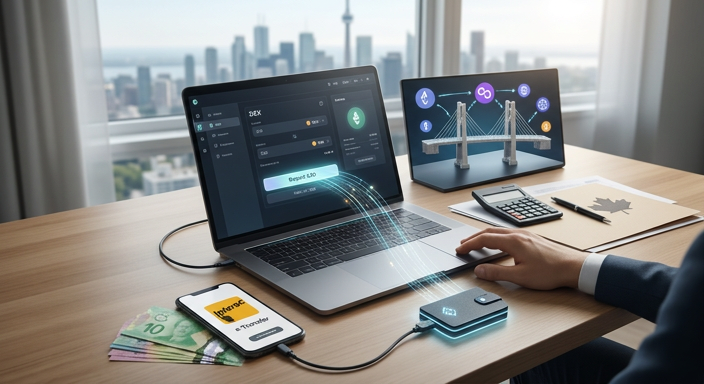
DeFi On‑Ramp in Canada 2026: How to Move CAD to DEXs with Interac, Bridges, Self‑Custody and CRA Tax
A practical DeFi on‑ramp in Canada 2026 guide for buyers: if your goal is to move Canadian dollars (CAD) into decentralized exchanges (DEXs) and DeFi protocols while keeping control of your keys, minimising fees, and staying CRA‑compliant, this guide walks you through the safest, most efficient workflows. It covers Interac e‑Transfer on‑ramps, CAD to stablecoin or Ethereum routing, bridging between chains, non‑custodial wallet setup, security checks, and the key CRA tax considerations every Canadian DeFi user should know.
Table of Contents
- Table of Contents
- What is a DeFi on‑ramp and why it matters
- Canadian on‑ramp options: Interac, exchanges, and P2P
- Step‑by‑step workflow: CAD to DEX (fast & secure)
- Secure route (recommended for most Canadians)
- Fast route (for experienced traders or urgent trades)
- Bridging and using DEXs safely
- Security and self‑custody best practices
- CRA tax implications for DeFi users (Canadian context)
- Quick comparison: On‑ramp options for Canadians
- Cost‑saving tips and practical examples
- FAQ
- 1) Can I use Interac e‑Transfer to buy USDC and bridge it to other chains?
- 2) Is it better to buy ETH or USDC before using DeFi?
- 3) How do I minimise CRA reporting headaches?
- 4) What are the biggest risks when moving funds to DeFi from Canada?
- 5) Which wallets are best for DeFi interaction in Canada?
- Conclusion and next‑step checklist
Table of Contents
- What is a DeFi on‑ramp and why it matters
- Canadian on‑ramp options: Interac, exchanges, and P2P
- Step‑by‑step workflow: CAD to DEX (fast & secure)
- Bridging and using DEXs safely
- Security and self‑custody best practices
- CRA tax implications for DeFi users
- Quick comparison: On‑ramp options for Canadians
- FAQ
- Conclusion and next‑step checklist
What is a DeFi on‑ramp and why it matters
A DeFi on‑ramp is the path you take from fiat (CAD) into decentralised finance (DEXs, lending, yield farming). On‑ramps vary by custody, cost, speed, and regulatory profile. Choosing the right route matters: it affects fees, counterparty risk, your ability to interact across chains, and how the Canada Revenue Agency (CRA) will treat your transactions.
Canadian on‑ramp options: Interac, exchanges, and P2P
Most Canadians use one of these on‑ramps to reach DeFi:
- Centralized Canadian or international exchanges that accept Interac e‑Transfer and let you buy CAD pairs or stablecoins.
- Fiat‑to‑crypto platforms (apps or brokerages) offering instant card or debit purchases.
- Peer‑to‑peer (P2P) trading and OTC desks for larger purchases or lower KYC exposure.
Recommendation for most buyers: buy a stablecoin (USDC/USDT) or Ethereum (ETH) on a regulated exchange that supports Interac e‑Transfer, then withdraw to a non‑custodial wallet before using DEXs. For step‑by‑step buying guidance, see the Canadian guides to buying How to buy Ethereum in Canada and buying How to buy stablecoins in Canada.
Step‑by‑step workflow: CAD to DEX (fast & secure)
Below are two common workflows. Choose the secure option if you value self‑custody; choose the fast option when time is critical and you accept temporary custody risk.
Secure route (recommended for most Canadians)
- Open an account at a Canadian or global exchange that supports Interac e‑Transfer.
- Use Interac e‑Transfer to deposit CAD, buy USDC or ETH (buying stablecoins first reduces exposure to price swings).
- Set up a hardware wallet or trusted non‑custodial wallet. Verify device authenticity and firmware before use (protecting your hardware wallet).
- Withdraw USDC or ETH to your self‑custody wallet in a single transaction to minimise fees.
- Use a reputable bridge or swap on the chain of choice, then interact with DEXs from your wallet.
Fast route (for experienced traders or urgent trades)
- Buy ETH on an exchange and keep holdings on the exchange while executing trades via exchange order books or integrated DEX access.
- If access to a DEX on another chain is needed, use a trusted custodial bridge offered by an exchange or OTC provider.
- Move to self‑custody after trades settle.
Bridging and using DEXs safely
Bridges and DEXs are powerful but carry protocol and smart contract risk. Follow these safe practices:
- Limit the amount you bridge on first use. Test with a small transaction to confirm address, gas, and timelines.
- Use well‑known bridges and inspect contract addresses. Unverified or unaudited bridges have led to permanent losses.
- Set slippage tolerances conservatively on DEXs (0.3% to 1% depending on pair liquidity). For low‑liquidity tokens, use higher slippage only if you accept MEV and sandwich risk.
- Check gas price estimates and bundle transactions when possible. For Ethereum, consider Layer 2s (Optimism, Arbitrum) to reduce fees for DEX trades.
- When possible, use wrapped native tokens and canonical stablecoins (USDC) to avoid unsupported tokens on target chains.
Security and self‑custody best practices
Self‑custody gives you control but requires discipline. Follow these steps:
- Buy hardware wallets only from official channels and verify device firmware before first use. See our hardware wallet verification guide for Canadians (Protecting your hardware wallet).
- Create backups and perform recovery drills. Regularly test that you can restore a wallet from your backup without exposing secrets (Prove you can recover).
- Use separate wallets for high‑value holdings and for active DeFi trading to limit exposure to compromised dApps.
- Never share seed phrases. Consider multisig for larger treasuries or long‑term holdings.
CRA tax implications for DeFi users (Canadian context)
CRA treats cryptocurrency transactions as either capital gains or business income depending on facts. DeFi users commonly face these tax events:
- Buying crypto with CAD is not a taxable event, but selling or trading crypto for other crypto or fiat usually triggers a disposition.
- Swapping tokens (e.g., USDC to an ERC‑20) is a disposition and must be reported — calculate gain/loss on the disposed token using its cost basis in CAD.
- Yield and rewards earned in DeFi (interest, liquidity provider fees, token emissions) are typically taxable as income when received and again on disposition.
- Bridging between chains can trigger dispositions if the bridge wraps or swaps tokens; track and report accurately.
Record keeping: keep exchange trade history, on‑chain transaction records, bridge receipts, and screenshots of wallet addresses. Use on‑chain explorers and transaction exporters to build audit trails for CRA. If in doubt about classification (capital vs business), consult a Canadian tax professional with crypto experience.
Quick comparison: On‑ramp options for Canadians
| Option | Typical Fees | KYC | Speed | Custody |
|---|---|---|---|---|
| Canadian exchange (Interac e‑Transfer) | Low to medium | Yes | Hours | Custodial until withdrawal |
| International exchange | Low | Yes | Minutes to hours | Custodial until withdrawal |
| P2P (local buyer/seller) | Variable | Optional | Minutes to days | Can be non‑custodial |
| Broker/Card buys | High | Yes | Instant | Custodial or instant delivery |
Cost‑saving tips and practical examples
- Batch transfers: consolidate exchange withdrawals into one transfer to your hardware wallet to reduce multiple withdraw fees.
- Use Layer 2s for frequent small trades to avoid expensive Ethereum gas fees.
- When bridging, compare bridge fees and withdrawal times — sometimes swapping on the source chain to a canonical bridge token reduces total cost.
- Keep a small hot wallet for active DeFi and the bulk of holdings in cold storage to reduce risk of dApp compromises.
FAQ
1) Can I use Interac e‑Transfer to buy USDC and bridge it to other chains?
Yes. Buying USDC with Interac via a Canadian exchange is a common route. After withdrawal to your wallet, you can bridge USDC to other chains. Always test with a small amount first and confirm whether bridging triggers taxable dispositions.
2) Is it better to buy ETH or USDC before using DeFi?
Buying USDC reduces exposure to price volatility during transfers and is often cheaper to bridge. Buying ETH is useful if you plan to transact on Ethereum L1 or pay gas in ETH. For many DeFi strategies, buy USDC then swap on‑chain as needed.
3) How do I minimise CRA reporting headaches?
Keep detailed records: fiat deposit receipts, exchange trade history, wallet addresses, on‑chain tx hashes, and bridge confirmations. Use crypto tax software to import transactions and generate reports. For complex activity, consult a Canadian crypto tax accountant.
4) What are the biggest risks when moving funds to DeFi from Canada?
Smart contract risk, bridge vulnerabilities, human error when copying addresses, and phishing dApps. Reduce risk by using hardware wallets, well‑audited bridges, small test transfers, and only interacting with reputable contracts.
5) Which wallets are best for DeFi interaction in Canada?
Use a hardware wallet (Ledger, Trezor, or other verified devices) for large holdings and a software wallet (MetaMask, WalletConnect) linked to a hardware signer for day‑to‑day DeFi. Verify hardware authenticity and firmware before use. See our guide on protecting your hardware wallet and run backup drills (Prove you can recover).
Conclusion and next‑step checklist
Moving CAD into DeFi in Canada is straightforward if you plan for custody, fees, and tax reporting. Use trusted on‑ramps, keep control of private keys, and document every step for CRA compliance.
- Choose a reliable exchange with Interac e‑Transfer support and buy USDC or ETH.
- Set up and verify a hardware wallet before withdrawing funds.
- Withdraw in a single transaction to reduce fees, then test any bridge with a small transfer.
- Record all transactions and consult a Canadian tax professional if activity is complex.
- Run wallet recovery drills and keep firmware updated to reduce supply‑chain risk.
If you want a step‑by‑step buying walkthrough before moving to DeFi, start with our Canadian guides to buying Ethereum and stablecoins, and review hardware wallet verification tips in Protecting your hardware wallet.